News / Star Wars: Episode IV - A New Hope
Star Wars: Episode IV - A New Hope
Summary
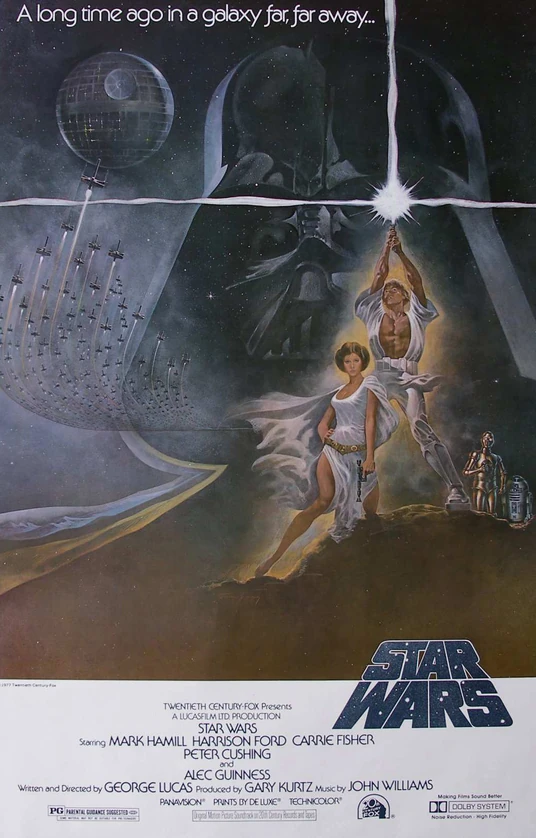
Star Wars: Episode IV - A New Hope is the movie that started everything, both chronologically within the saga and in historical terms. Released on May 25, 1977, it revolutionized the film industry, established the modern blockbuster paradigm, and created one of the most successful and enduring entertainment franchises in history. Directed by George Lucas, who wrote the screenplay along with Lawrence Kasdan, the movie introduced the world to a universe that would become a global cultural phenomenon.
The story follows Luke Skywalker, a young farmer from Tatooine whose life changes dramatically when he acquires two droids, C-3PO and R2-D2, containing secret plans for the Death Star, a powerful weapon of mass destruction of the Galactic Empire. Luke discovers the existence of the Force, a mystical energy that connects all living beings, through the eccentric Jedi Knight Obi-Wan Kenobi, who reveals his true legacy as part of an ancient order of protectors of peace and justice in the galaxy.
The narrative combines elements of Western mythological tradition with science fiction, creating a space fairy tale that resonated with audiences of all ages. Luke's journey from his mundane life on his uncle's farm to becoming a hero who destroys the Death Star represents the archetype of the hero's call that has fascinated humanity for millennia.
The film also establishes the foundations for the interpersonal relationships that will define the saga: the mentor-apprentice relationship between Obi-Wan and Luke, the budding romance between Han Solo and Leia, and the rivalry between Luke and Han that will evolve into a deep friendship. The final confrontation between Obi-Wan and Darth Vader in the Death Star corridor established one of the most iconic antagonists in film history.
Fun Facts
- With a budget of only $11 million, the movie grossed over $775 million worldwide.
- It won 6 Oscar awards including Best Original Score and Best Visual Effects.
- Before its release, executives from major studios had rejected Lucas's script.
- John Williams's score became instantly recognizable.
A New Hope proved that artistic intuition sometimes outperforms traditional commercial analysis, and established the basis for over four decades of Star Wars content.